
Change is an inevitable part of working with living systems, but permaculture design empowers us to embrace change as the seed of new opportunities!
Author Archives: Tyler Butkus
Permaculture Design Basics: Value Edges and Transitional Spaces

Edges offer opportunities to pack diversity and interaction into a system. Learn about the 11th principle of permaculture design: Value Edges and Transitional Spaces!
Permaculture Design Basics: Utilize Diversity

Diversity builds resilience and adaptability within systems. The 10th Permaculture Design Principle reminds us to utilize this as a force for creating more sustainable systems!
Permaculture Design Basics: Favor Slow and Small Interventions

Systems thinking lends a helpful insight into why slow, small interventions are often more effective and sustainable than large, dramatic changes. Read this article on the 9th principle of permaculture design: favor slow and small interventions!
Permaculture Design Basics: Integrate Elements and Functions
Every element supports many functions and important functions are supported by multiple elements. This is how integrated, resilient systems are designed, and in this article I explore how to build resiliency, adaptability, and efficiency using the eighth permaculture design principle.
Permaculture Design Basics: Design From Patterns to Details
Permaculture design looks at multiple layers of patterns to discover how design elements can work together to have the greatest impact. This article explains how to design from patterns to details!
Permaculture Design Basics: Produce No Waste
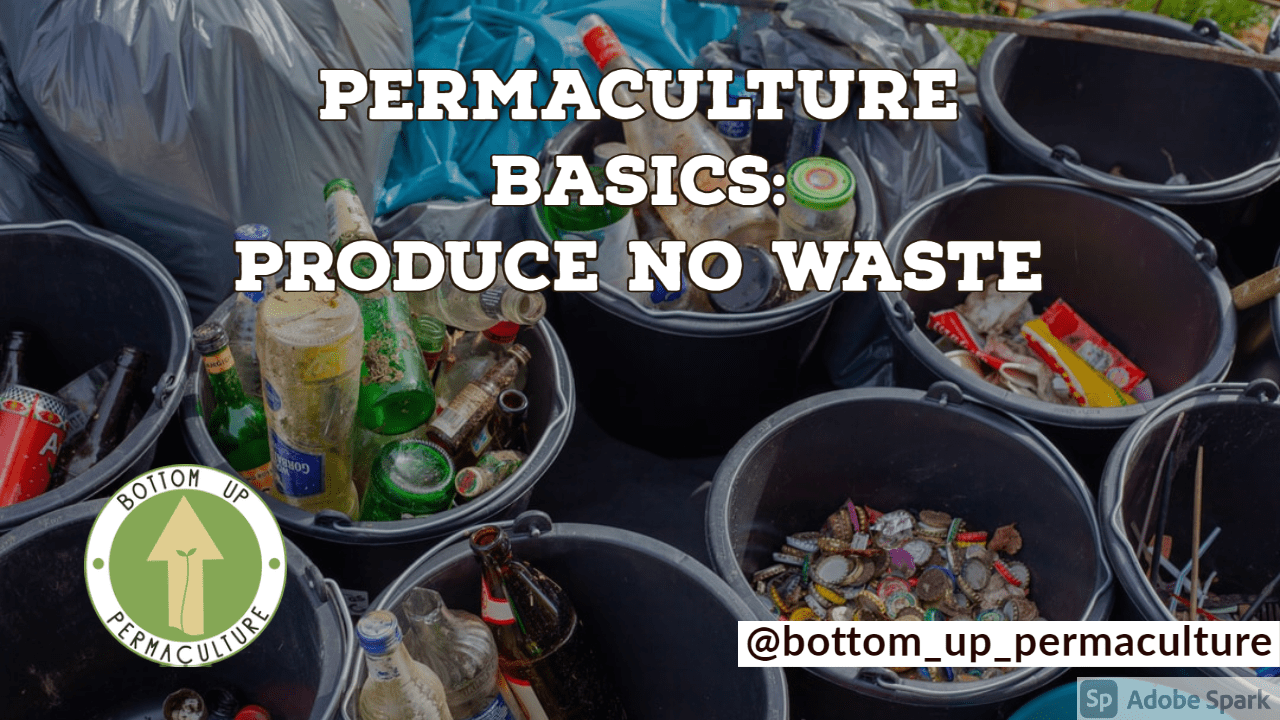
Waste is a human invention, but luckily it is one we control. Follow these steps to help reduce your waste footprint and live more sustainably!
Permaculture Design Basics: Utilize Renewable, Rather Than Finite Resources

Renewable resources allow us to create endless abundance without depleting nature. This article discusses the unique characteristics of renewable resources, as well as how to utilize them to their greatest effect.
Permaculture Design Basics: Apply Feedback

Feedback keeps our designs rooted in reality and ensures we don’t waste resources on unrealistic designs. This article explores the role of applying feedback in permaculture design.
Permaculture Design Basics: Obtain a Yield
In order for any system to be sustainable, it needs to offer something back to the designer. Obtaining a Yield is the third principle of permaculture design, which I discuss further in this article.
 Bottom Up Permaculture